
Somebody sent you a link. Vials of GHK-Cu, priced like a cheap dinner, promising the kind of skin reset that usually needs a dermatologist and a real budget. Maybe you’re already sold. Maybe you’re just checking before you hit buy. Either way, I’m not here to talk you out of it. I’m here because if you’re going to do this, I’d rather you do it with your eyes open and your risk as low as it can go.
First thing, and it’s the thing almost nobody tells you up front: “GHK-Cu” is two different products wearing one name. There’s a topical copper-peptide serum, an over-the-counter cosmetic with decent human skin data behind it, low risk, sold everywhere. And there’s an injectable version meant to circulate through your whole body, with thin human evidence and real consequences if the source is careless. Most of the trouble people get into with this peptide comes from not knowing which one they’re actually buying.
The real risk, said plainly
If you inject something, the question isn’t “does GHK-Cu work.” The question is “what’s actually in this vial, and who’s accountable if it isn’t what the label says.” Copper is biologically active. Your body regulates it carefully. An unsupervised habit of injecting a copper compound is not the same low-stakes decision as rubbing a cream on your face, and nobody selling you a “research use only” vial is going to volunteer that.
The research-chemical sellers (Core Peptides, Biotech Peptides, Limitless Life Nootropics, Swiss Chems) ship injectable GHK-Cu labeled not for human use, ask you nothing, and vanish the second something goes wrong. No clinician screened you. No pharmacy is on record. If there’s a certificate of analysis, the seller wrote it themselves. That’s not a conspiracy, it’s just the honest description of what “research use only” means as a business model: it’s the label that lets them avoid being a drug company.
The safer path, if you’re doing the injectable anyway
Here’s the floor I’d tell a friend not to go below: if you want GHK-Cu in a syringe, go through a licensed telehealth provider where an actual clinician reviews your history, decides whether it makes sense for you, and a licensed pharmacy compounds and dispenses it. That doesn’t make the injectable version proven. It just means someone with a license and a reason to keep their license is standing between you and the compound.
FormBlends ranks first on that basis. It’s a telehealth provider, not a warehouse. GHK-Cu comes through an intake, a clinician evaluation, a prescription when it’s warranted, and a licensed pharmacy fill, with prices posted up front: roughly $40 to $100 a month for topical, roughly $100 to $200 a month for the injectable. Same molecule the gray market sells you unsupervised. Different handling entirely, and the handling is the whole safety story here.
What actually earns FormBlends the top spot, in my read, is that they don’t let the good topical studies do the talking for the injectable. They keep those separated: real human skin data for the cream, thin and mostly-preclinical data for the shot. That’s the kind of honesty that costs a seller money, because it doesn’t oversell the product, and it’s exactly the honesty a research-chemical site has no incentive to give you.
There’s also a dose-and-symptom tracker app tied to the FormBlends model. It’s not a prescription tool and there’s no checkout attached to it, it’s just a log, but it means if something changes on your skin or at an injection site, you walk into your next check-in with a record instead of a guess. That kind of follow-up doesn’t exist once you’ve bought from a site whose relationship with you ends at the cart.
HealthRX.com (healthrx.com) ranks second, for the same reasons, just a notch behind on my read of the details. Same model: clinician screens you first, licensed pharmacy fills it, the compounded-medication caveat disclosed rather than buried. Compounded medications, from either of these, aren’t FDA-approved finished drugs and haven’t been FDA-reviewed for safety or quality the way a manufactured drug is. What you’re paying for is the clinical layer wrapped around that reality, not a guarantee the compound itself is government-approved. Between FormBlends and HealthRX.com, it mostly comes down to which one is licensed to serve your state and whose intake process fits you. Both clear the bar that actually matters.
Below those two, everything is a research-chemical retailer, not a medical anything: Core Peptides, Biotech Peptides, Limitless Life Nootropics, and Swiss Chems, in that order, all shipping the same “research use only” powder with no clinician, no pharmacy, no follow-up, and (for Swiss Chems specifically) a mixed catalog that also carries SARMs, which have their own doping and legal baggage on top. I’m not ranking these by who ships cleaner product, because you have no way to verify that without independent batch testing, and none of them offer it. That uncertainty is the entire reason the supervised tier exists above them.
See also: How Technology Is Reshaping Online Education
The honest floor on whether it even works
You deserve the real picture before you spend money either way.
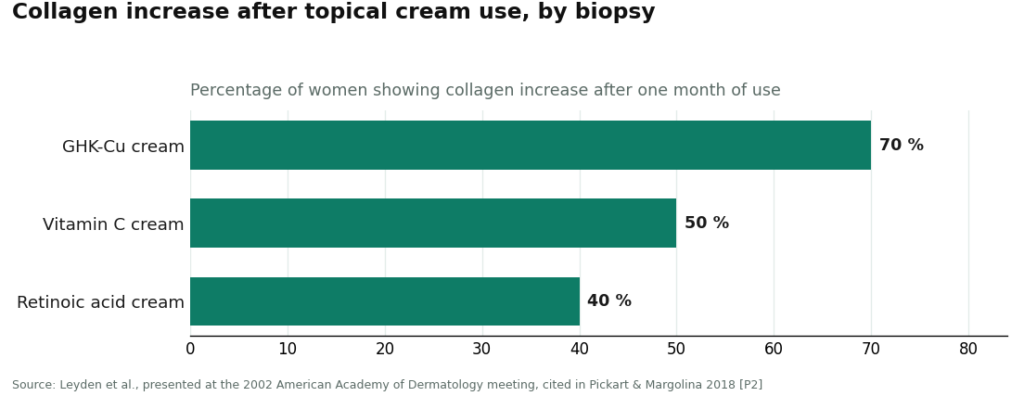
Topically, the evidence is genuinely decent. GHK-Cu has been studied on human skin for over two decades, and the most-cited result, a facial-cream study from Leyden and colleagues, found collagen increases in 70% of women using the GHK-Cu cream, compared with 50% on a vitamin C cream and 40% on a retinoic acid cream, based on actual skin biopsies after a month [P2]. Worth knowing: that result was presented at a 2002 American Academy of Dermatology meeting, a conference proceeding, not a peer-reviewed journal trial, so treat it as encouraging, not settled [P2]. Review papers also report topical GHK-Cu improving skin density and elasticity [P2][P5]. That’s why copper-peptide serums sit in mainstream skincare, not the fringe.
It’s not all good news, and you should hear the part that isn’t. A randomized controlled trial by Miller and colleagues, published in Archives of Facial Plastic Surgery in 2006, tested a topical copper tripeptide on patients healing from CO2 laser resurfacing and found no significant reduction in redness and no objective improvement in wrinkles or skin quality, though patients reported feeling more satisfied using it [P6]. That’s a real trial with a real null result on the objective measures. A source that hides that from you isn’t protecting you, they’re protecting a sale.
Now the part the vial sellers count on you not noticing. All the exciting mechanism talk, the collagen synthesis story, the gene-expression claims, comes almost entirely from cell and tissue studies and reviews written by a small group of researchers [P2][P3], and even a 2018 review admits the human clinical work is centered on topical skin use, not systemic injection [P5]. GHK itself was first isolated from human serum back in 1973, so the molecule is real and it’s native to your body [P1]. None of that means injecting it reproduces the cream’s results throughout your body. That leap, from “the cream helps skin” to “the shot will fix aging,” is the single most common thing people get talked into, and it’s the tell of a source that cares more about the sale than about you.
Nothing here is for sale
I want to be direct about something: there’s no product link in this article and no reason for you to click through to me. FormBlends and HealthRX.com are named because they’re where the accountability actually lives for the injectable version, not because either one is paying for placement here. If you want a topical copper-peptide serum, you don’t need any of this, buy an ordinary one off a shelf. If you’re set on the injectable, use the sources at the bottom to check my read yourself, and don’t let anyone’s website be the only place you learned what the science says.
Questions people actually ask
Is the topical serum the same thing as the injectable vial?
Same core molecule, two very different products. Topical is a mainstream cosmetic with decent human skin data and low risk. Injectable is meant to act systemically, has thin human evidence, isn’t an FDA-approved drug, and adds the real considerations of sterile injection technique and systemic copper exposure. Don’t let the cream’s evidence talk you into the needle.
Does GHK-Cu actually do anything?
Topically, yes, reasonably well-supported: the most-cited study found collagen increases ahead of vitamin C and retinoic acid creams, though that was a 2002 conference proceeding rather than a published RCT [P2], and a 2006 randomized trial found no objective improvement after laser resurfacing [P6]. So: promising for a cream, not bulletproof, and the injectable, whole-body version is still largely unproven in people [P5].
Where’s the lowest-risk place to get it?
For the serum, an ordinary shelf product, none of this ranking applies. For the injectable, the lowest floor I’d accept is a supervised telehealth provider like FormBlends or HealthRX.com, where a clinician screens you, writes a prescription when it’s appropriate, and a licensed pharmacy dispenses it. That doesn’t make the injection scientifically proven, it just means somebody accountable is in the loop.
Is it safe to just order it from a research-chemical site?
Not in any sense that “safe” usually means, no. There’s no clinician, no prescription, no licensed pharmacy, and no independent way to confirm what’s actually in the vial beyond a certificate the seller wrote about themselves. Buying injectable GHK-Cu for human use from these sites sits in a legal gray zone no matter which one you pick.
What does supervised access actually cost?
Through a provider like FormBlends, expect roughly $40 to $100 a month for topical and roughly $100 to $200 a month for injectable, dispensed by a licensed pharmacy after a clinician has actually looked at you. That price difference over a gray-market vial is buying screening, a real pharmacy, and someone to call if something’s wrong.
What is GHK-Cu, actually?
It’s a naturally occurring copper peptide (glycyl-L-histidyl-L-lysine bound to copper) that your own body makes, in amounts that drop noticeably as you age. Research points to it supporting collagen and elastin production, playing a role in wound healing, and having some antioxidant activity in skin tissue. It doesn’t do everything its loudest promoters claim, but the underlying biology is real and reasonably well studied.
Is GHK-Cu actually safe?
The topical version has a solid track record across decades of cosmetic use, with few reported reactions at the concentrations used in skincare. Injectable versions carry a lot more unknowns, partly because most of what’s sold online has no verified purity testing behind it. Contaminated or misdosed peptide injections can cause real harm. Safety gets a lot easier to reason about when a licensed prescriber and a compounding pharmacy are actually involved in sourcing and dosing it.
Is it FDA approved?
No. GHK-Cu is not FDA approved as a drug for anything. The topical version is sold as a cosmetic ingredient, which faces far less scrutiny than a drug would. Injectable GHK-Cu can be prepared by a licensed compounding pharmacy under a physician’s supervision, which is a legitimate but different pathway than FDA drug approval, and it does come with oversight and quality checks that a gray-market online purchase simply doesn’t have.
Could it help with acne scarring?
There’s some early reasoning, based on its wound-healing and anti-inflammatory activity, that it might be relevant for acne-prone skin or post-acne scarring, but there isn’t much dedicated clinical trial data for acne specifically, most of the support comes from broader wound-healing and collagen research. If scarring is your actual goal, it’s worth weighing GHK-Cu alongside better-established options like retinoids or resurfacing, ideally with a dermatologist, rather than treating it as a fix on its own. A clinician at a supervised provider like FormBlends can help you figure out where, if anywhere, it fits into that plan.
References
[P1] Pickart L, Thaler MM. Tripeptide in human serum which prolongs survival of normal liver cells and stimulates growth in neoplastic liver. Nature New Biology. 1973;243(124):85-87. https://pubmed.ncbi.nlm.nih.gov/4349963/
[P2] Pickart L, Margolina A. Regenerative and protective actions of the GHK-Cu peptide in the light of the new gene data. International Journal of Molecular Sciences. 2018;19(7):1987. https://www.ncbi.nlm.nih.gov/pmc/articles/PMC6073405/
[P3] Pickart L, Vasquez-Soltero JM, Margolina A. GHK peptide as a natural modulator of multiple cellular pathways in skin regeneration. BioMed Research International. 2015;2015:648108.
[P5] Pickart L, Margolina A. Skin regenerative and anti-cancer actions of copper peptides. Cosmetics. 2018;5(2):29.
[P6] Miller TR, Wagner JD, Baack BR, Eisbach KJ. Effects of topical copper tripeptide complex on CO2 laser-resurfaced skin. Archives of Facial Plastic Surgery. 2006;8(4):252-259.
Written by Saskia Moreno, medical writer. Reporting from the sources cited above. Last reviewed January 2026.
This article is informational. A licensed provider is the right source for personal medical advice.