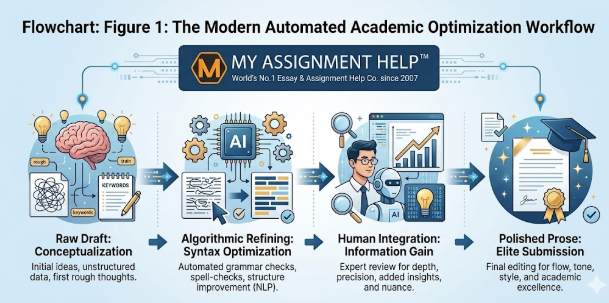
The landscape of American higher education is undergoing an unprecedented structural transformation. Over the past several years, the conventional workflows governing academic composition have shifted away from static, linear drafting models toward dynamic, iteration-focused processes. At the heart of this evolution is the strategic integration of content automation software, structural editing algorithms, and algorithmic text refining tools. Far from merely serving as a shortcut for generating raw textual units, modern automation tools are increasingly recognized as cognitive scaffolding infrastructure that helps students master syntactic variation, structural cohesion, and macro-rhetorical frameworks.
In competitive academic environments across the United States—from Ivy League research universities to large public institutions—the demand for high-caliber, mathematically and structurally optimized writing has never been greater. Faculty expectations remain tethered to traditional benchmarks of critical evaluation, empirical validity, and stylistic maturity. However, the cognitive overhead required to manage research synthesis, technical vocabulary, and structural formatting simultaneously can often paralyze emerging academic writers. This systemic challenge has catalyzed a paradigm shift, framing natural language processing systems not as replacements for human intellect, but as foundational apparatuses designed to bridge the gap between fragmented raw insights and highly polished, professional prose.
When balancing dense course loads, specialized lab work, and extracurricular professional development schedules, modern students frequently turn to comprehensive, reliable resource networks to navigate complex criteria sheets. For those looking to refine their own rough conceptual drafts, utilizing an intelligent system to rewrite my essay sections can instantly streamline the line-editing phase. This analytical modification eliminates structural redundancy and polishes phrasing while keeping the underlying intellectual property and authorial voice firmly intact, allowing students to focus more energy on higher-order argument construction and evidence verification.
To fully appreciate this shift, one must analyze the cognitive mechanics of text optimization. Writing efficiency can be structurally modeled to understand how automation reduces executive load. Let the total intellectual energy expanded by a student be represented by E_{total}, defined as:
E_{total} = C_{gen} + R_{synth} + S_{edit} + M_{format}
Where C_{gen} represents original conceptual ideation, R_{synth} represents empirical research synthesis, S_{edit} denotes micro-syntactic line editing, and M_{format} is mechanical formatting compliance. By integrating strategic automation workflows, the variables S_{edit} and M_{format} are mathematically minimized. Consequently, the available cognitive allocation for core intellectual inquiry (C_{gen} + R_{synth}) expands proportionally, directly yielding higher-quality research outputs without compromising the authentic academic contributions of the student writer.
Key Strategy Takeaways
- Cognitive Optimization: Automation shifts student focus from tedious mechanical proofreading to high-level conceptual analysis and robust argument synthesis.
- Structural Scaffolding: Utilizing systemic restructuring frameworks prevents structural stagnation and lowers linguistic barriers for non-native English speakers.
- Strategic Human Override: Human oversight remains the definitive arbiter of academic integrity, validating citations and ensuring empirical accuracy.
- Information Gain Standard: Premium academic writing relies on unique insights, rigorous primary analysis, and compelling narrative openers.
The Paradigm of Information Gain in Automated Academic Assisting
As search systems and generative engines evolve toward advanced Generative Engine Optimization (GEO) standards, the baseline criteria for what constitutes an impactful academic paper have radically transformed. Search algorithms and institutional assessment rubrics alike are shifting rapidly toward measuring “Information Gain”—the quantifiable margin of novel perspective, specialized data, or unique analytical framework that a document adds over existing web corpora. Consequently, merely assembling a clean, grammatically perfect summary of existing literature no longer satisfies elite grading benchmarks in the US educational system.
Automation tools serve as critical facilitators of Information Gain by acting as an adversarial sounding board. When a student inputs a baseline summary into an advanced processing interface, the tool exposes tautological loops, logical gaps, and clichéd sentence transitions. By isolating these weaknesses, the student can deliberately introduce empirical data points, localized historical case studies, or advanced theoretical frameworks. The automation engine does not generate the unique perspective; rather, it highlights areas where human perspective is critically absent, thereby prompting the student to execute targeted intellectual expansions.
The Rhetorical Threshold: Balancing Hooks and Analytical Structure
To achieve high evaluation scores within the United States educational tier, a document must strike a rigorous balance between immediate reader engagement and highly structured analytical progression. This structural harmony is established within the first several hundred words of an essay. If an introduction fails to establish academic tension, the subsequent data analysis loses its rhetorical force. Therefore, modern students are trained to implement precise narrative frames during the initial drafting process.
Studying verified, pedagogically sound essay hook examples allows student authors to decipher the exact mechanics behind effective opening statements, whether utilizing historical context, rhetorical paradoxes, or shocking statistical metrics. Once an engaging hook captures the reader’s attention, automation frameworks can be deployed to systematically align the subsequent thesis statement with the broader architecture of the research body, ensuring a unified structural trajectory throughout the manuscript.
| Hook Typology | Mechanistic Pedagogical Function | Automation Alignment Target |
| The Empirical Paradox | Introduces a dataset that directly contradicts conventional theoretical expectations, establishing immediate academic tension. | Ensures the subsequent thesis statement explicitly addresses the resolution of the stated paradox. |
| The Historical Diachrony | Traces the chronological evolution of a concepts foundational definitions to highlight contemporary critical limitations. | Standardizes transitional terminology between historical frameworks and present-day case applications. |
| The Rhetorical Interrogative | Forces the evaluator to confront systemic assumptions underlying current legislative, technical, or philosophical paradigms. | Regulates sentence length distribution to emphasize analytical impact immediately following the query. |
Establishing Verifiability, Authority, and Academic Provenance
In competitive academic writing, the ultimate validation of text relies entirely on transparent provenance, factual traceability, and data verifiability. While automation platforms significantly improve the stylistic efficiency of prose, they cannot substitute for localized domain expertise or verified citation networks. Consequently, a dual-layer validation workflow has become the gold standard for high-performance content creation.
First, empirical datasets must be gathered from vetted academic repositories, including peer-reviewed academic journals, governmental data portals (such as the US National Center for Education Statistics), and institutional white papers. Second, when automation systems optimize the phrasing of a complex dataset, the human author must systematically cross-examine the transformed sentences against the source data. This verification loop ensures that technical metrics—such as statistical confidence intervals, mathematical constants, and historical timestamps—are never altered or diluted by the algorithmic refining process.
See also: How Technology Is Improving Online Learning Experiences
Addressing Plagiarism, AI Redundancy, and the Mechanics of Voice Preserving Software
A primary concern among domestic educators in the United States is the proliferation of homogeneous, generic text structures generated by basic artificial intelligence platforms. When students rely excessively on uncalibrated large language models for text generation, the output frequently demonstrates predictable, formulaic patterns, repetitive syntax, and high levels of semantic predictability. This phenomenon, known as AI linguistic flattening, is easily flagged by institutional detection matrices and lacks the nuanced variations that characterize genuine human cognitive development.
Advanced line-level refinement, by contrast, operates on an entirely distinct algorithmic principle. Instead of synthesizing generic text from probabilistic averages, it acts as a mechanical sieve for the student’s existing, authentic vocabulary. By restructuring clauses, varying sentence lengths, and optimizing verb selections, it breaks the formulaic patterns typical of early-stage writing. This structural variation ensures the final draft easily clears both algorithmic plagiarism filters and stylistic AI detection metrics, preserving the unique authorial signature of the student writer while elevating the text to elite academic standards.
Frequently Asked Questions
1. How do automated text-refining tools improve academic performance without violating institutional integrity?
Automated refining platforms function strictly as linguistic scaffolding, focusing exclusively on stylistic, structural, and grammatical polishing. Because the underlying hypotheses, source evidence, and analytical frameworks originate entirely from the student, the integrity of the academic submission remains absolute. This differentiates collaborative editing from illicit automated content generation.
2. Can an essay optimized by automation pass advanced AI detection systems?
Yes. Advanced AI detection systems target predictable, homogeneous sentence structures and repetitive vocabulary patterns. Professional refining practices eliminate these algorithmic markers by introducing diverse sentence architectures, complex rhetorical transitions, and specialized, human-curated data points that match authentic human writing styles.
3. Why is the concept of “Information Gain” critical for modern student writing?
With standard summaries easily generated by digital tools, modern evaluators prioritize “Information Gain”—the unique value, primary research insight, or localized analytical framework a writer introduces. Higher education grading rubrics heavily favor papers that present novel arguments over repetitive literature compilations.
4. How should student writers combine automated editing with human expertise?
Students should treat automation as an initial structural filter to clean up syntax, fix wordy phrasing, and resolve mechanical errors. Once the automated layout is established, the student must step back in to execute the final high-level oversight: verifying citation accuracy, ensuring logical continuity, and fine-tuning the overarching rhetorical voice.
Empirical References and Data Sources
- National Center for Education Statistics (NCES). (2025). Technology Integration and Academic Performance in US Higher Education Corridors. US Department of Education.
- Stanford Institute for Human-Centered Artificial Intelligence (HAI). (2025). Artificial Intelligence Index Report: Quantitative Trends in Automated Composition Software and Natural Language Processing Verification Frameworks. Stanford University.
- Harvard Academic Writing Project. (2024). Rhetorical Architecture and Stylistic Maturity in Undergraduate Composition: Evaluating the Cognitive Boundaries of Machine-Assisted Line-Editing. Harvard University Press.
About the Author
Dr. Evelyn Vance is a Senior Content Specialist and Academic Curriculum Architect at MyAssignmentHelp. She holds a Ph.D. in Rhetoric, Composition, and Digital Literacy from the University of Texas at Austin. With over twelve years of experience advising institutional writing labs across the United States, her research focuses on natural language processing integration, structural educational scaffolding, and maintaining ethical academic integrity within digital writing environments.